A Complete Simulation Study with causalsim
simulation-study.RmdOverview
Evaluating causal estimators requires knowing the answer.
causalsim gives you that by making the data-generating
process explicit: you specify the structural model, the package
simulates data from it, and you measure how well any estimator recovers
the truth you specified.
What this vignette covers
| Step | Function | What it does |
|---|---|---|
| 1 | causalsim_dgp() |
Define the structural model and true ATE |
| 2 | causalsim_draw() |
Simulate one dataset and inspect it |
| 3 | causalsim_eval() |
Measure estimator performance over many replications |
| 4 | causalsim_grid() |
Sweep over sample sizes and confounding levels |
library(causalsim)Step 1: Define the DGP
The structural model for this study is:
In causalsim_dgp() terms: one standard-normal
confounder, a constant effect of 2, moderate propensity confounding
(logistic coefficient 0.5), and a moderate baseline shift.
dgp <- causalsim_dgp(
  n             = 500,
  n_confounders = 1,
  effect        = 2,
  propensity    = "moderate",
  baseline      = "moderate"
)
dgp
#> <causalsim_dgp>
#>   n            : 500
#>   true ATE     : 2.0000
#>   heterogeneous: FALSE
#>   sigma        : 1.00
#>   covariates   :
#>     W       normal  [confounder]
The true ATE is exact when effect is a scalar — no Monte
Carlo approximation is needed. For function-valued effects,
causalsim_dgp() approximates the ATE via 10,000 Monte Carlo
draws at construction time.
Step 2: Inspect a Draw
causalsim_draw() simulates one dataset from the DGP. The
columns .tau and .p are the individual causal
effect and propensity score — diagnostic metadata that is not available
in real observational data.
dat <- causalsim_draw(dgp, seed = 1L)
head(dat)
#>            W A          Y .tau        .p
#> 1 -0.6264538 0 -1.7679183    2 0.4223273
#> 2  0.1836433 0 -0.7538327    2 0.5229393
#> 3 -0.8356286 0 -1.6682940    2 0.3970399
#> 4  1.5952808 0  1.4649285    2 0.6894695
#> 5  0.3295078 1  0.8739842    2 0.5410956
#> 6 -0.8204684 0 -2.4452377    2 0.3988560
With moderate confounding, the treated and control groups differ on the pre-treatment covariate:
aggregate(W ~ A, data = dat, FUN = mean)
#>   A          W
#> 1 0 -0.2440553
#> 2 1  0.3162376
That difference is exactly what makes naive regression biased. Any
estimator that omits W will absorb part of its association
with Y into the treatment coefficient.
Step 3: Define Estimators
An estimator is any function that accepts the data frame returned by
causalsim_draw() and returns a named numeric vector. The
ci_lower and ci_upper fields are optional but
enable coverage and power metrics.
# Naive: regresses Y on A only — omits the confounder
naive_est <- function(data) {
  fit <- lm(Y ~ A, data = data)
  est <- coef(fit)[["A"]]
  se  <- sqrt(vcov(fit)["A", "A"])
  c(estimate = est, ci_lower = est - 1.96 * se, ci_upper = est + 1.96 * se)
}

# OLS: adjusts for the observed confounder W
ols_est <- function(data) {
  fit <- lm(Y ~ A + W, data = data)
  est <- coef(fit)[["A"]]
  se  <- sqrt(vcov(fit)["A", "A"])
  c(estimate = est, ci_lower = est - 1.96 * se, ci_upper = est + 1.96 * se)
}
Named lists are also accepted, so the following is equivalent:
ols_est <- function(data) {
  fit <- lm(Y ~ A + W, data = data)
  ci  <- confint(fit)["A", ]
  list(
    estimate = coef(fit)["A"],
    ci_lower = ci[1],
    ci_upper = ci[2]
  )
}
Step 4: Evaluate Each Estimator
causalsim_eval() runs reps independent
replications and returns a tidy summary of bias, RMSE, coverage, and
power with Monte Carlo standard errors.
eval_naive <- causalsim_eval(dgp, naive_est, reps = 300L, seed = 1L)
eval_naive
#> <causalsim_eval>  reps: 300  true ATE: 2
#>
#>    metric  value      se
#>      bias 0.2353 0.00587
#>      rmse 0.2562 0.00571
#>  coverage 0.3700 0.02787
#>     power 1.0000 0.00000
eval_ols <- causalsim_eval(dgp, ols_est, reps = 300L, seed = 1L)
eval_ols
#> <causalsim_eval>  reps: 300  true ATE: 2
#>
#>    metric   value      se
#>      bias -0.0002 0.00529
#>      rmse  0.0915 0.00338
#>  coverage  0.9433 0.01335
#>     power  1.0000 0.00000
The naive estimator’s bias is substantial: treatment is positively correlated with , which also raises through the baseline, so the unadjusted coefficient absorbs part of that association. OLS eliminates the bias by conditioning on . Coverage for the naive estimator falls well below the nominal 95% because the confidence intervals are centered on the wrong value.
summary() adds the full distribution of per-replication
estimates, and plot() shows it as a histogram:
summary(eval_ols)
#> <causalsim_eval_summary>  reps: 300  true ATE: 2
#>
#> Estimate distribution:
#>   mean  : 1.9998
#>   sd    : 0.0916
#>   median: 2
#>   [p10, p90]: [1.883, 2.1217]
#>
#> Metrics:
#>    metric   value      se
#>      bias -0.0002 0.00529
#>      rmse  0.0915 0.00338
#>  coverage  0.9433 0.01335
#>     power  1.0000 0.00000
plot(eval_ols)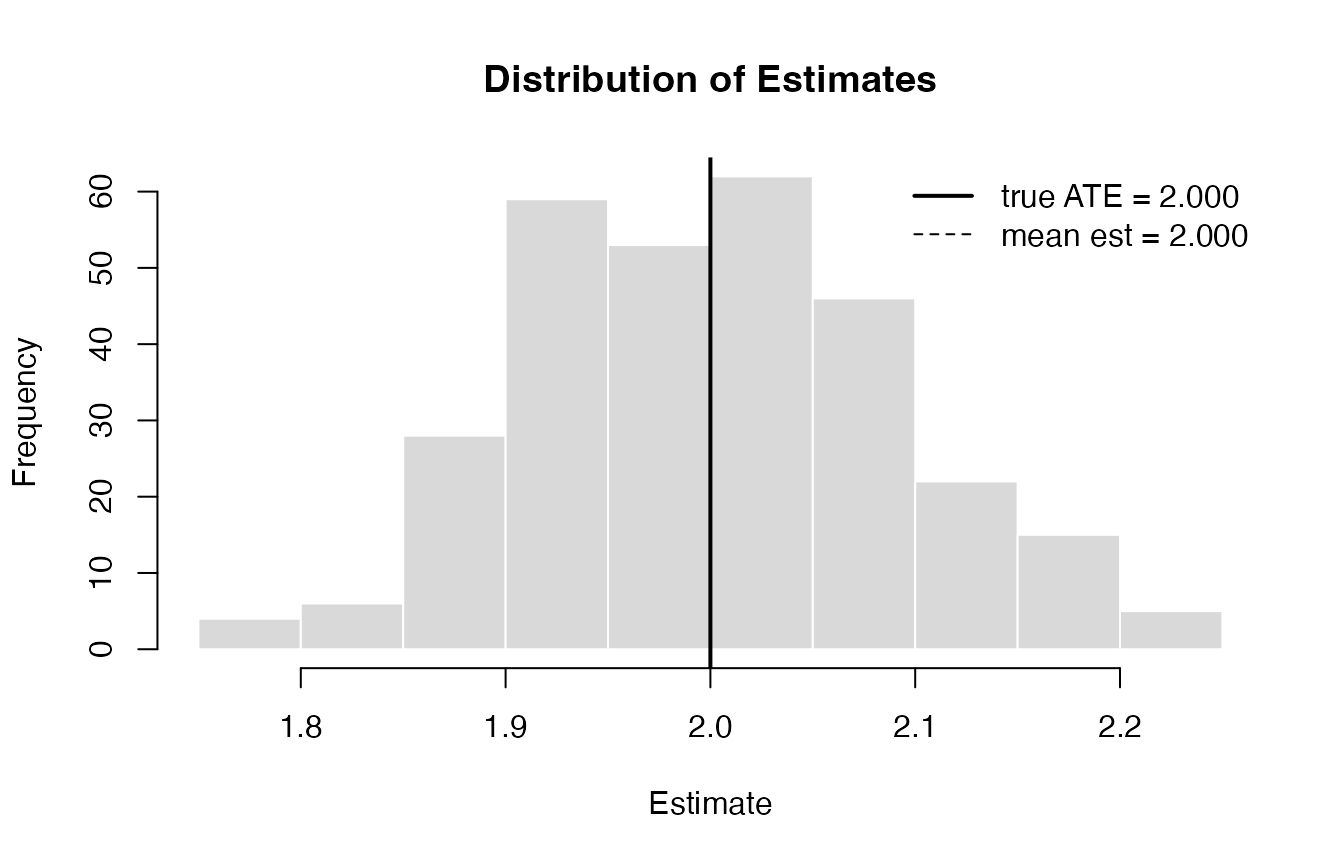
Distribution of OLS estimates over 300 replications. Solid line: true ATE. Dashed line: mean estimate.
Step 5: Vary Sample Size with causalsim_grid()
causalsim_grid() evaluates an estimator over the
Cartesian product of the supplied parameter values, returning a tidy
data frame of metrics for each cell. Here we vary n across
four levels to track how the OLS estimator’s precision improves with
more data.
grid_n <- causalsim_grid(
  dgp       = dgp,
  estimator = ols_est,
  vary      = list(n = c(100L, 250L, 500L, 1000L)),
  reps      = 300L,
  metrics   = c("bias", "rmse"),
  seed      = 1L
)
grid_n
#> <causalsim_grid>  4 cells  vary: n  reps/cell: 300
#>   metrics: bias, rmse
#>
#>     n metric        value          se
#>   100   bias -0.018028707 0.012266598
#>   100   rmse  0.212874118 0.009119602
#>   250   bias  0.014982725 0.007414731
#>   250   rmse  0.129085151 0.004892668
#>   500   bias  0.003375758 0.005195662
#>   500   rmse  0.089904798 0.003940619
#>  1000   bias  0.003163125 0.003734224
#>  1000   rmse  0.064648194 0.002489179
RMSE roughly halves as quadruples — consistent with -rate convergence for OLS in a correctly specified model. Bias stays near zero at every sample size.
Step 6: Vary Confounding Strength
Varying the propensity preset shows how bias scales with
confounding. Because causalsim_grid() accepts one estimator
at a time, we run it separately and combine the results.
conf_levels <- list(propensity = c("low", "moderate", "high"))

grid_naive <- causalsim_grid(dgp, naive_est,
                              vary    = conf_levels,
                              reps    = 300L,
                              metrics = "bias",
                              seed    = 1L)

grid_ols   <- causalsim_grid(dgp, ols_est,
                              vary    = conf_levels,
                              reps    = 300L,
                              metrics = "bias",
                              seed    = 1L)

comparison <- rbind(
  cbind(estimator = "naive", grid_naive$results),
  cbind(estimator = "ols",   grid_ols$results)
)
comparison <- comparison[order(comparison$propensity, comparison$estimator), ]
rownames(comparison) <- NULL
comparison
#>   estimator propensity metric         value          se
#> 1     naive       high   bias  0.4089432973 0.006098827
#> 2       ols       high   bias -0.0001855971 0.005888572
#> 3     naive        low   bias  0.1305019380 0.005990692
#> 4       ols        low   bias  0.0045047637 0.005556133
#> 5     naive   moderate   bias  0.2419929827 0.005443921
#> 6       ols   moderate   bias -0.0008346139 0.005360097
Naive bias grows proportionally with confounding strength. OLS remains near zero across all three levels because is observed and included in the model.
Where to go next
This workflow — define, evaluate, grid — scales to more complex settings. A few directions:
| Goal | How |
|---|---|
| Heterogeneous effects | Pass a function to effect in
causalsim_dgp()
|
| Non-normal covariates | Use covar("binary") or covar("uniform") in
covariates
|
| Multiple confounders | Set n_confounders = 3 or pass named
covariates
|
| Custom covariate structure | Mix n_confounders with explicit
covariates = list(...)
|
See ?causalsim_dgp and ?covar for the full
API.
Session info
sessionInfo()
#> R version 4.5.2 (2025-10-31)
#> Platform: aarch64-apple-darwin25.2.0
#> Running under: macOS Tahoe 26.1
#>
#> Matrix products: default
#> BLAS:   /opt/homebrew/Cellar/openblas/0.3.31_1/lib/libopenblasp-r0.3.31.dylib
#> LAPACK: /opt/homebrew/Cellar/r/4.5.2_1/lib/R/lib/libRlapack.dylib;  LAPACK version 3.12.1
#>
#> locale:
#> [1] C.UTF-8/C.UTF-8/C.UTF-8/C/C.UTF-8/C.UTF-8
#>
#> time zone: America/New_York
#> tzcode source: internal
#>
#> attached base packages:
#> [1] stats     graphics  grDevices utils     datasets  methods   base
#>
#> other attached packages:
#> [1] causalsim_0.0.0.9000
#>
#> loaded via a namespace (and not attached):
#>  [1] digest_0.6.37     desc_1.4.3        R6_2.6.1          fastmap_1.2.0
#>  [5] xfun_0.54         cachem_1.1.0      knitr_1.50        htmltools_0.5.8.1
#>  [9] rmarkdown_2.30    lifecycle_1.0.4   cli_3.6.5         sass_0.4.10
#> [13] pkgdown_2.2.0     textshaping_1.0.4 jquerylib_0.1.4   systemfonts_1.3.1
#> [17] compiler_4.5.2    tools_4.5.2       ragg_1.5.0        bslib_0.9.0
#> [21] evaluate_1.0.5    yaml_2.3.10       jsonlite_2.0.0    rlang_1.1.6
#> [25] fs_1.6.6          htmlwidgets_1.6.4